Recap: NL-NMD Clinical Symposium 2026
On 9 January, we kicked off the new year with the Clinical Neuromuscular Symposium. Unfortunately, due to heavy snowfall, the Research Symposium had to be postponed. On Monday, 30 March, this symposium will take place after all. Registration will be kept open until then, so feel free to sign up!
The Clinical Neuromuscular Symposium this year focused on the full life course of patients with neuromuscular diseases, from pregnancy and birth to older age. The program included insights into pregnancy guidance in genetic muscle disorders, growing up and becoming (young) adults with a muscle disease, social participation with a muscle disease, and advance care planning.
Highlights and updates from the past year were also discussed in two ‘Neuromuscular News’ sessions and the event concluded with a quiz followed by a networking reception.
This year the fifth edition of the NL-NMD Thesis Awards was organized by SCN young talent program MYOS. These awards aim to celebrate and promote outstanding contributions by young researchers in the field of neuromuscular diseases in the Netherlands. The best pre‑clinical thesis will be announced in March.
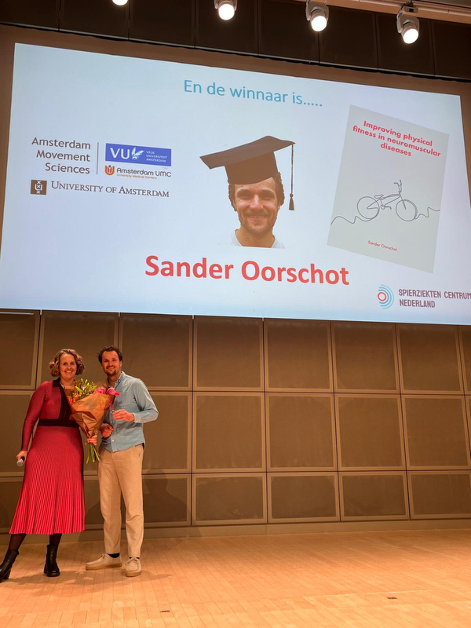
During the clinical symposium, Sander Oorschot received the NL‑NMD Thesis Award for the best clinical thesis for his work titled ‘Improving physical fitness in neuromuscular diseases’. The research in this thesis was embedded within the Amsterdam Movement Sciences Research Institute, at the department of Rehabilitation Medicine, Amsterdam UMC, location University of Amsterdam, the Netherlands. The thesis aimed to expand knowledge on improving physical fitness in people with NMD. Central was a high-quality, multicenter RCT evaluating the short- and long-term efficacy of the I’M FINE intervention on physical fitness, physical functioning, daily physical activity and quality of life in people with NMD, compared to usual care. The intervention proved safe and improved physical fitness by 10% directly post-intervention. Importantly, these results were achieved with a home-based program, whereas others used mainly hospital-based programs. Home-based programs are easier to implement into daily life and reduce travel demands and intensive therapist support. We warmly congratulate Sander on this award and hope he will continue to make a valuable impact for patients with neuromuscular disorders in the future!